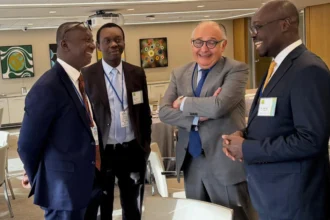


A United States-based Ghanaian professor, Stephen Kwaku Asare, has raised concerns about the recent High Court order affecting the prosecutorial powers of the Office of the Special Prosecutor (OSP).
In a Facebook post, Prof Asare cautioned against what he described as the potential weakening of Ghana’s anti-corruption framework, stressing that stakeholders must not be complicit in what he termed a “quiet dismantling” of the system.
His comments come amid assurances from the Attorney-General’s Department that it will comply with the court’s directive. Deputy Attorney-General, Justice Srem Sai, stated that “the Honourable Attorney-General has no intention or capacity to disobey or ignore the High Court’s order.”
The High Court in Accra, on Wednesday, April 15, ordered the Attorney-General’s Department to take over all ongoing prosecutions being handled by the OSP until the Office secures the constitutionally required authorisation to prosecute independently.
The ruling follows a legal challenge by Peter Archiblod Hyde, an accused person in an OSP-led case, who argued that the Office lacked the authority to prosecute without express approval from the Attorney-General. The court held that the OSP failed to demonstrate that it had obtained such authorisation.
Prof Asare, however, questioned both the interpretation of the law and the response by the Attorney-General’s office. He argued that if the issue is merely the absence of authorisation, then the appropriate remedy would be to grant that authorisation rather than halt the institution’s prosecutorial functions.
“If ‘authorisation’ is all that is lacking, then the most faithful response is to issue it. A curable defect calls for a curative response, not institutional displacement,” he stated.
He further pointed out what he described as a contradiction in the Attorney-General’s position, questioning how prosecutions deemed unauthorised could subsequently be taken over and continued by the same office.
Beyond the immediate legal dispute, Prof Asare raised broader constitutional concerns, arguing that the High Court’s directive effectively reassigns the prosecutorial mandate of a statutory anti-corruption body, a move he believes may exceed the court’s jurisdiction.
He also highlighted the structural framework underpinning the OSP, noting that the Attorney-General played a central role in establishing the Office, including sponsoring its enabling law and regulatory instruments, which vest prosecutorial discretion within the Special Prosecutor.
According to him, requiring prior authorisation from the Attorney-General contradicts the very framework that created the OSP and risks undermining its independence.
Prof Asare additionally referenced a pending case before the Supreme Court of Ghana, in which the constitutionality of the OSP is being challenged, warning that parallel legal developments could cumulatively weaken the institution.
“What is at stake is not a technical defect. It is whether a statutory mechanism designed to fight corruption will be enabled or quietly neutralised through procedure,” he stated.
He emphasised that Ghana’s progress in building anti-corruption institutions should not be reversed, urging careful consideration of both the legal and institutional implications of the ruling.
Meanwhile, the Attorney-General’s office has indicated that steps are being taken to implement the High Court’s order in the coming days.